FOOD R&D PLM · REAL SCREENS
See the whole app, screen by screen.
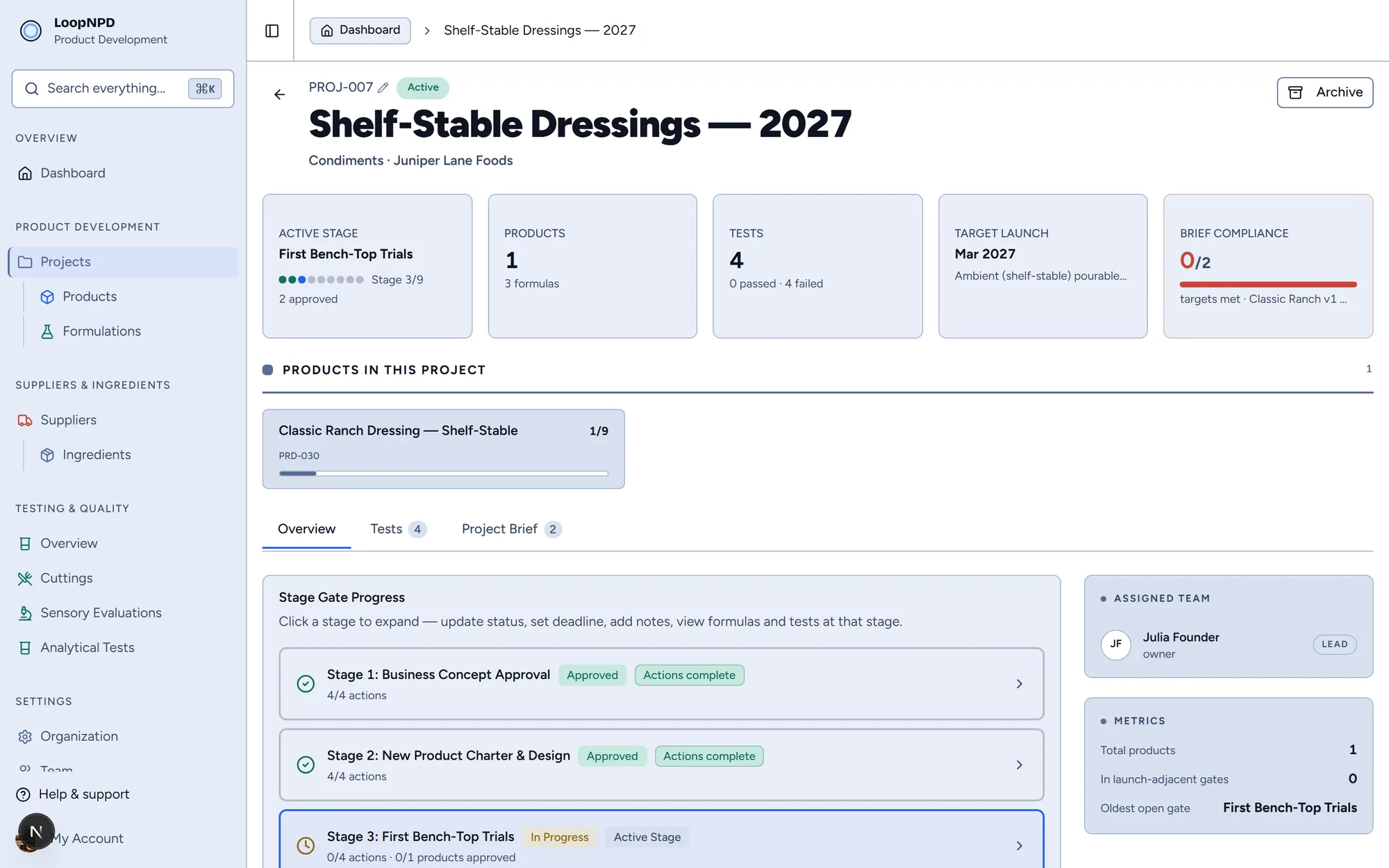
Every screenshot below is the real product: a shelf-stable ranch dressing moving through the stage-gate pipeline, failing a bench test, and getting fixed.
THE WALKTHROUGH
Click through it, step by step.
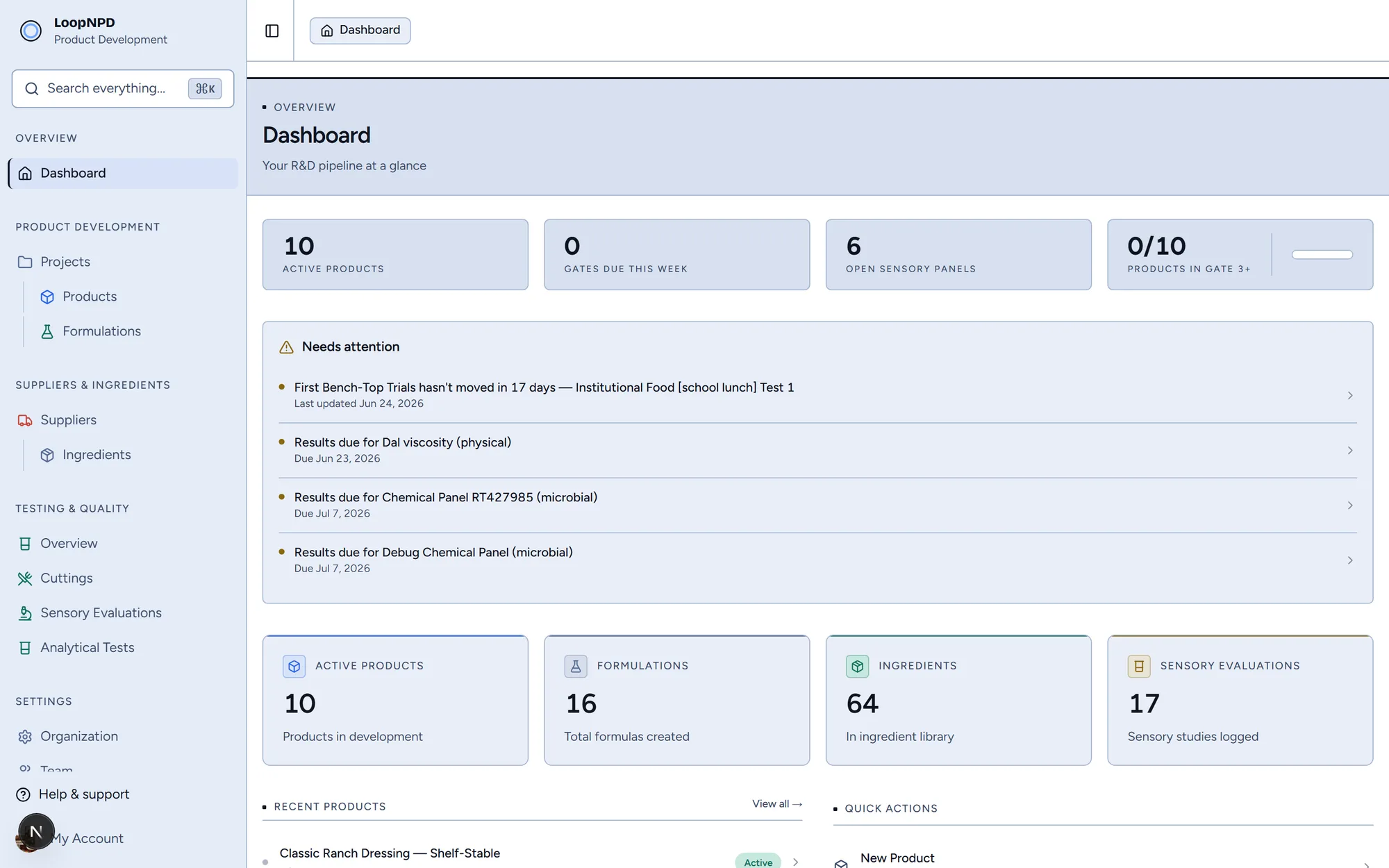
STEP 1 · THE MORNING VIEW
Your whole pipeline, one screen.
- Products, formulas, tests, and sensory panels: live counts
- “Needs attention” surfaces what stalled, so nothing slips
- Every number links straight to the record behind it
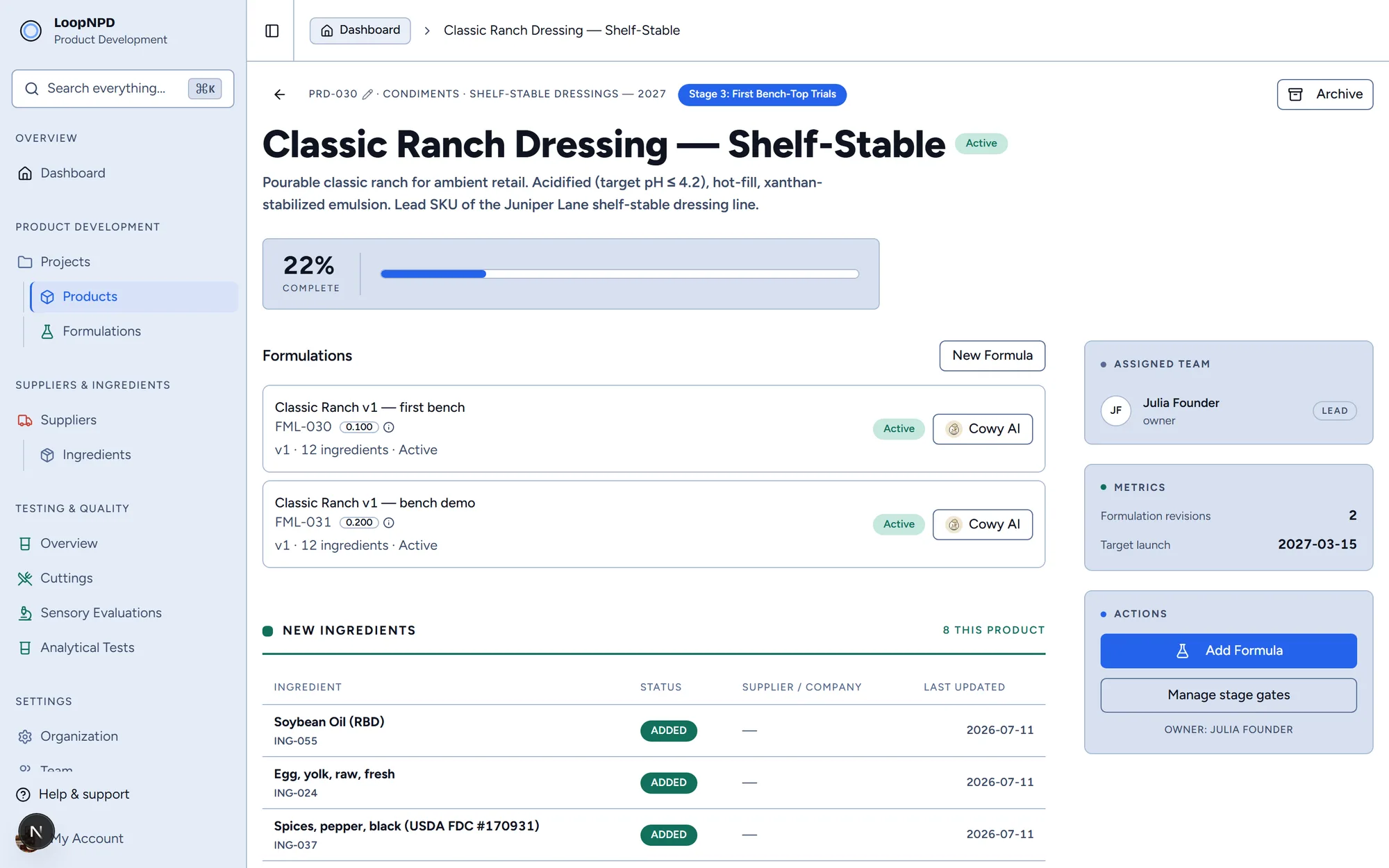
STEP 2 · THE STAGE-GATE MODEL
Every stage is a visible decision.
- Concept to post-launch review, stage by stage
- Approvals carry the approver and the date, no inbox archaeology
- Gate actions are checklists, not tribal knowledge
STEP 3 · THE PRODUCT
One home per product.
- Stage, formulas, new ingredients, and photos in one place
- Progress computed from real deliverables, not vibes
- Millie AI is one click away from any formula
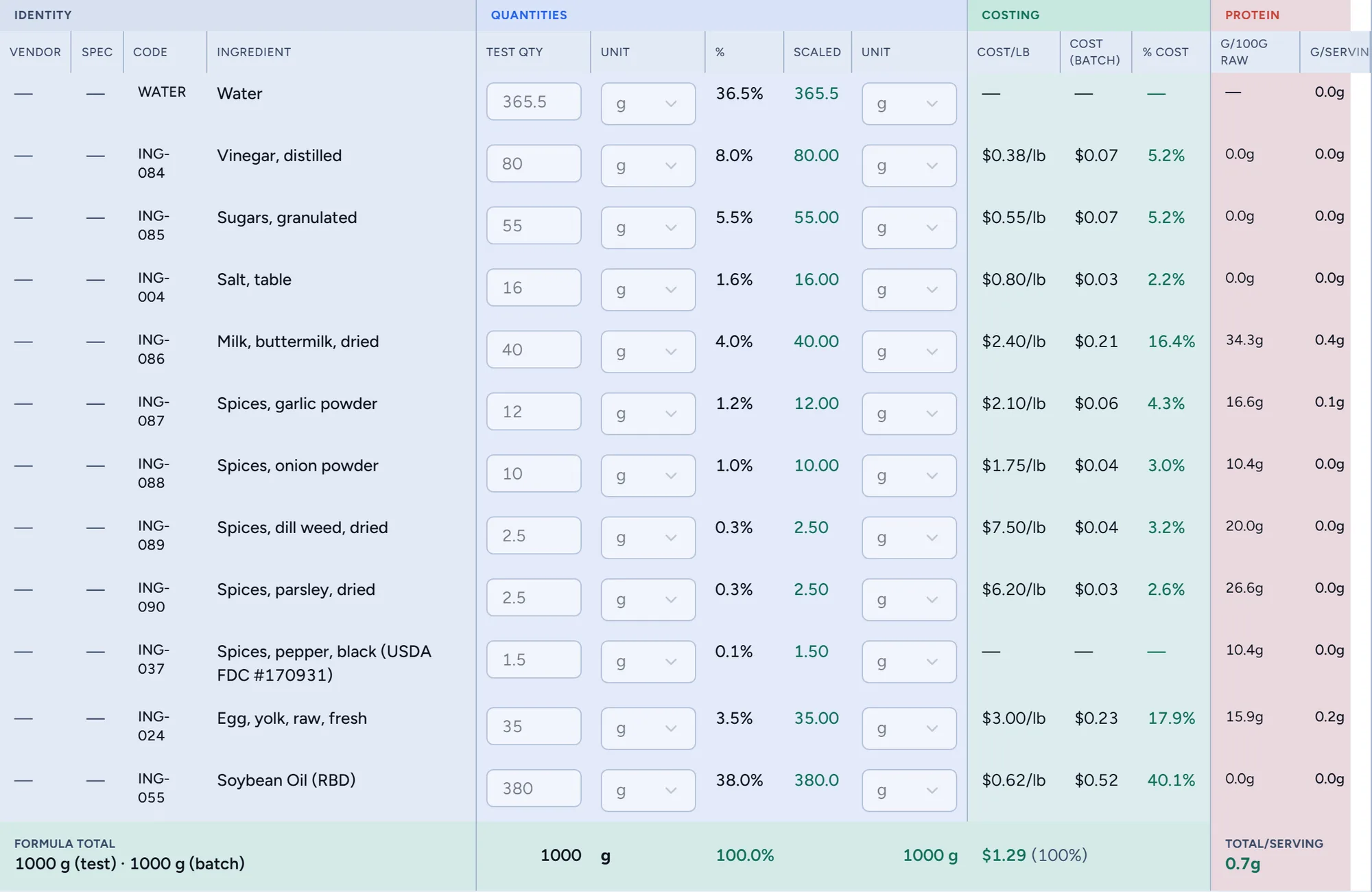
STEP 4 · THE FORMULA TABLE
The whole recipe, on one table.
- Every ingredient with its percentage, scaled batch amount, and cost
- Percentages always sum to 100%; cost and nutrition roll up live
- Versioned like code: diff any two, approve one for a stage
STEP 5 · THE MATH
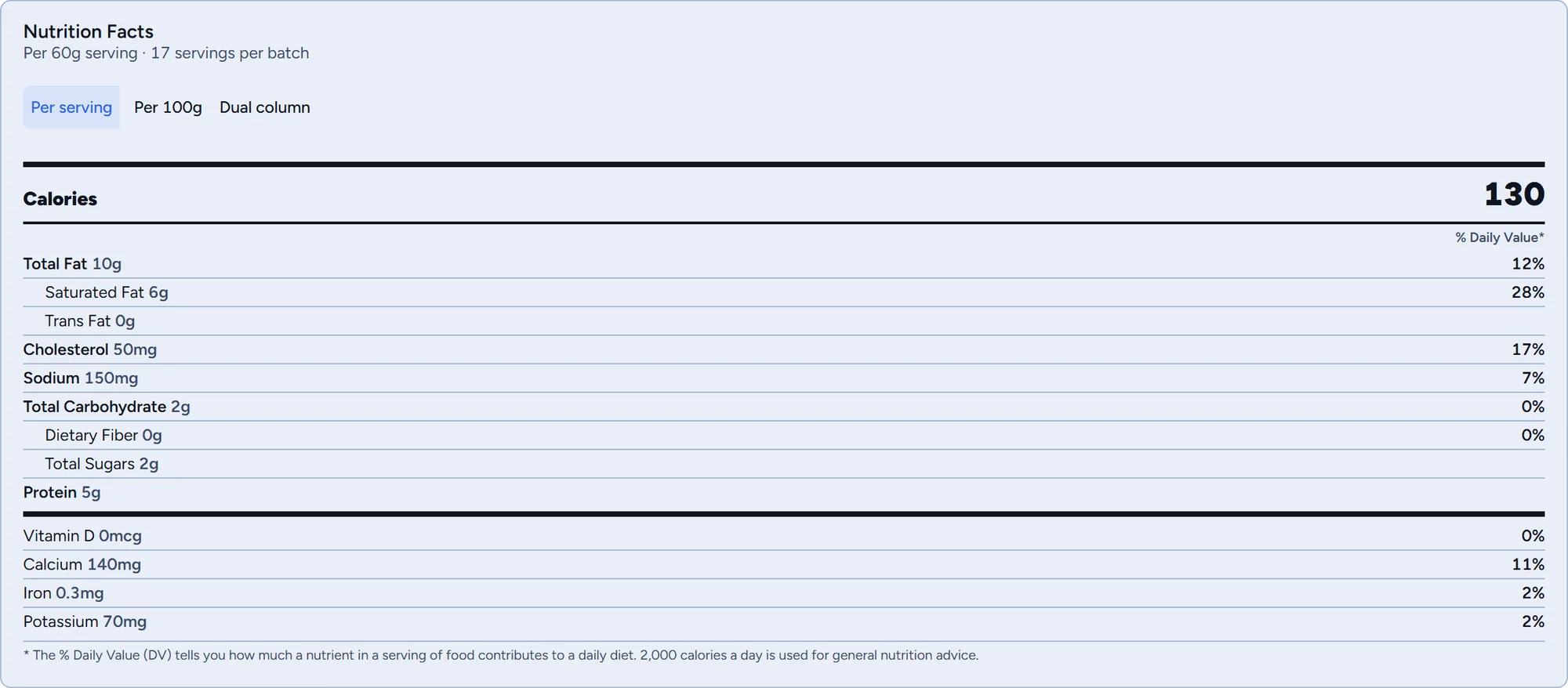
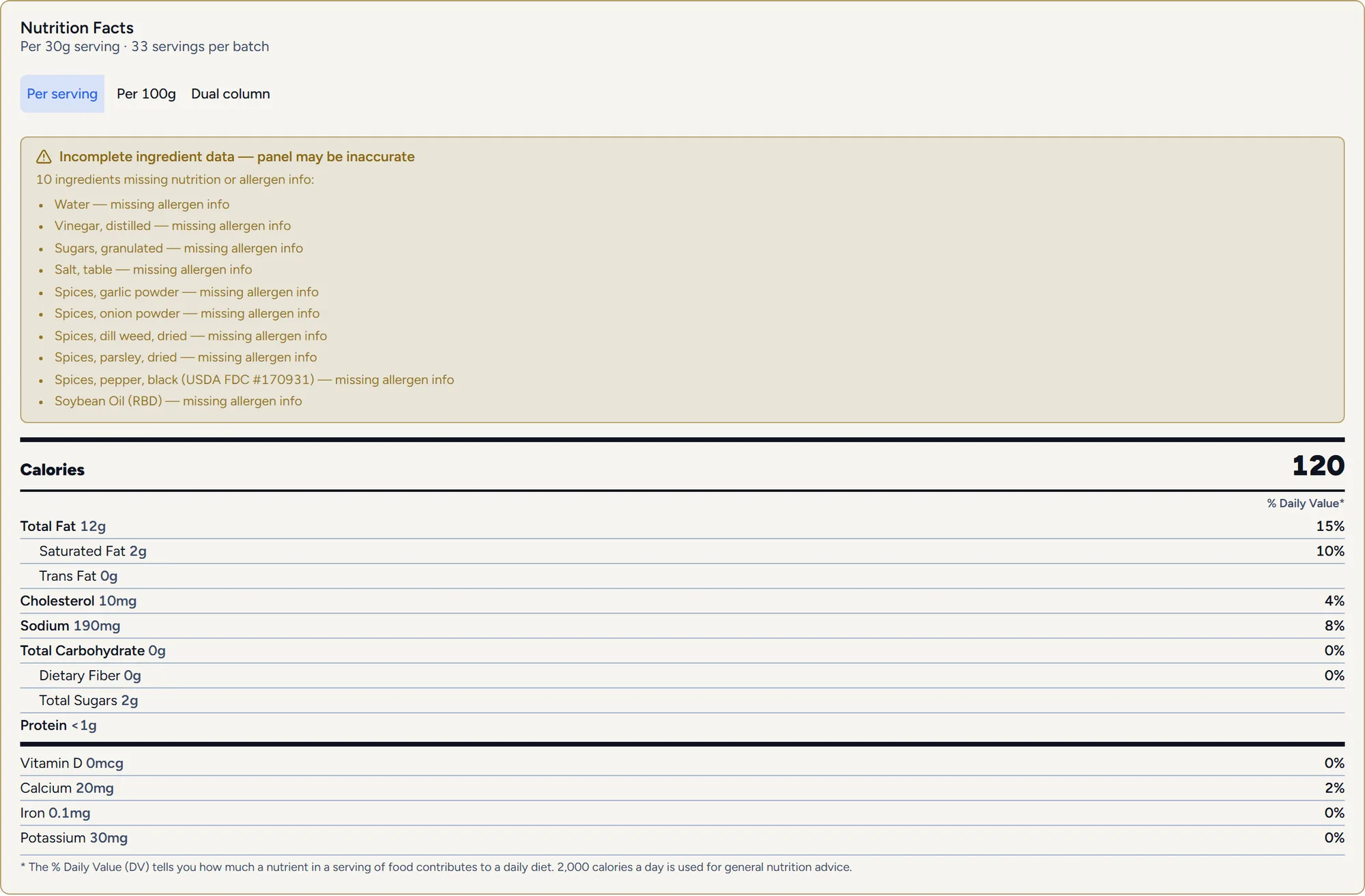
An FDA panel that recalculates as you build.
- FDA Nutrition Facts (21 CFR 101.9) recalculates as you type
- Complete ingredient data → a clean panel (below, top)
- Missing data → a yellow advisory naming what to fill in (below, bottom)
STEP 6 · ANALYTICAL
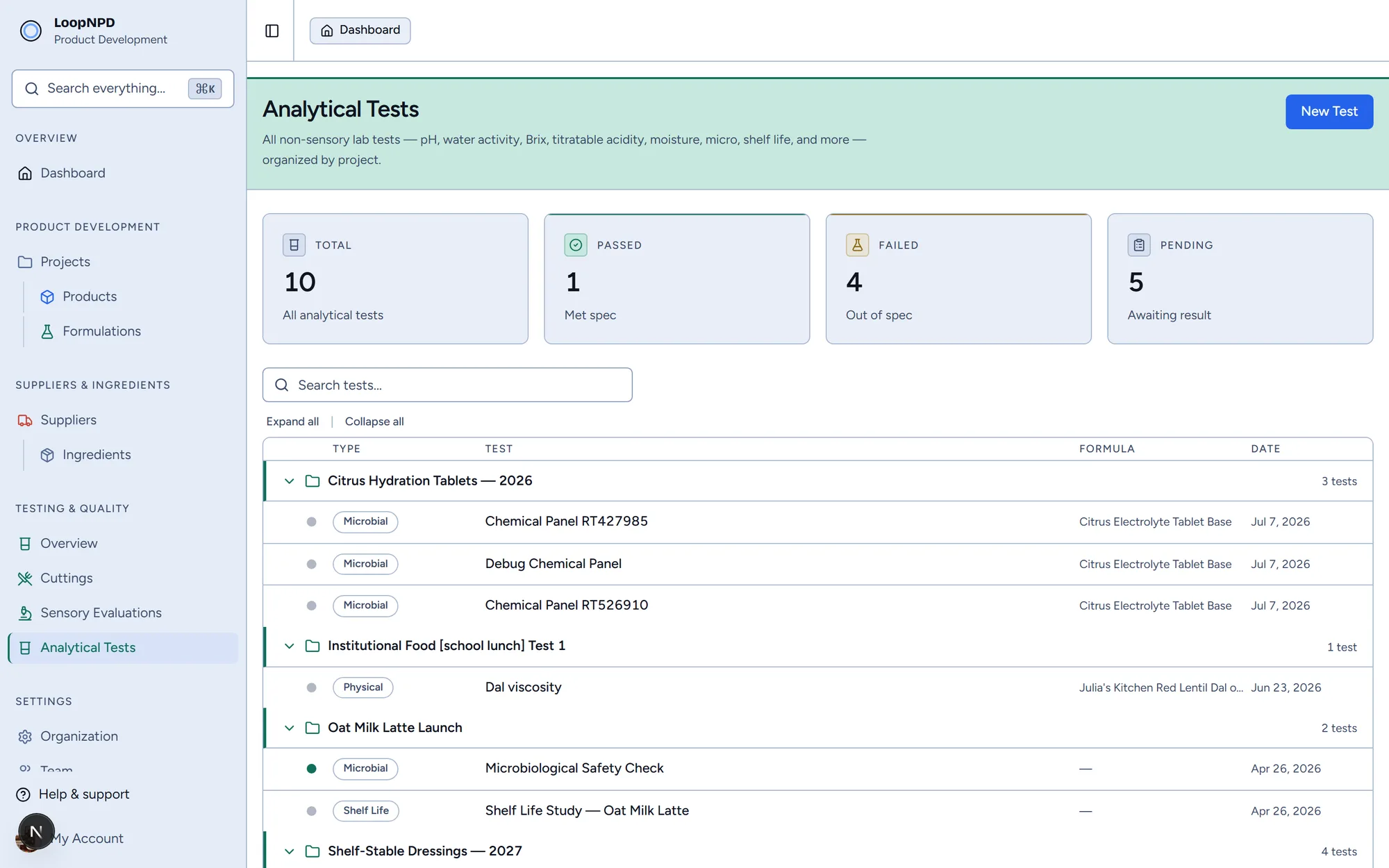
Tests attach to the version they measured.
- Logged against spec: pH, viscosity, water activity, micro
- Pass or fail scored against your project-brief targets
- A failed test is a visible status, not a buried PDF
STEP 7 · SENSORY
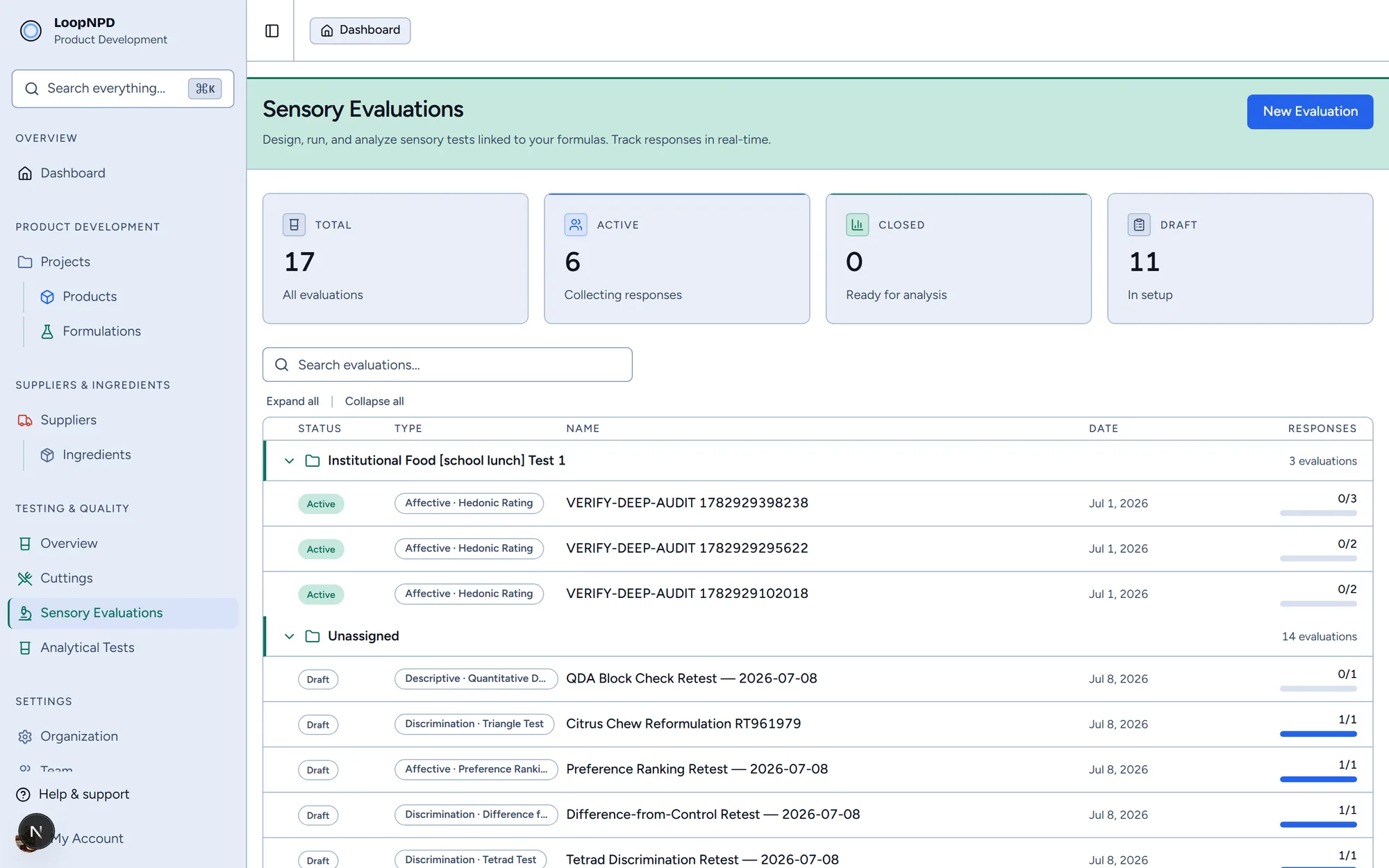
Panels linked to the exact version.
- Set up a study in a form; invite the panel by email
- Results land next to the formula, not on one desktop
- Compare liking across versions, attribute by attribute
STEP 8 · THE AI CO-PILOT
One click. Millie reads everything and writes the fix.
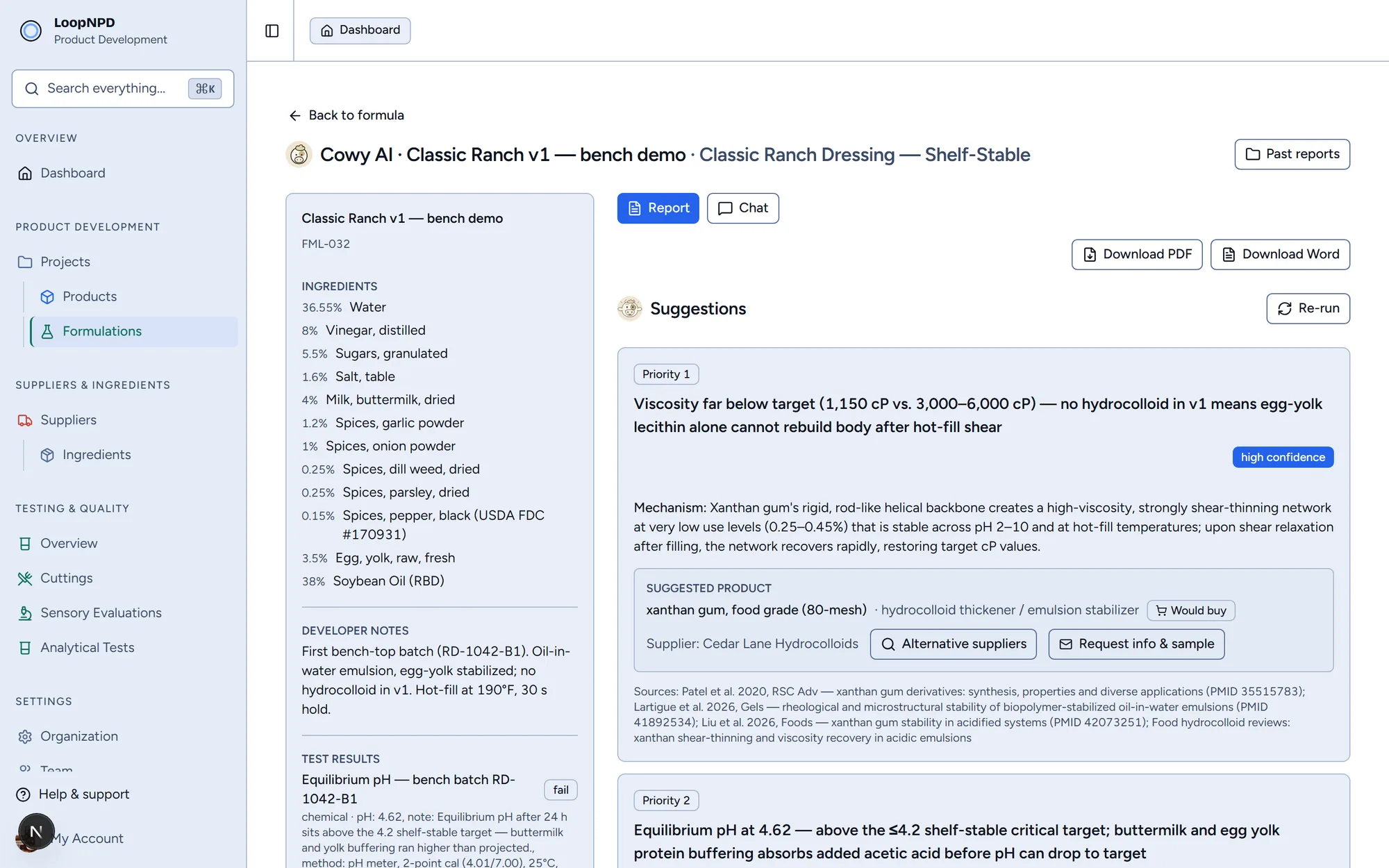
- You click Analyze. Millie pulls in the formula, every test, and the brief itself
- No prompting: it already knows the pH and viscosity failed
- It names the fix: ingredient type, use level, mechanism, and a supplier
1 / 8
ONE COLLEAGUE WHO HAS READ EVERYTHING
One click. Millie reads it all.
A bench batch missed both critical specs: pH 4.62 against a 4.2 ceiling, viscosity 1,150 cP against a 3,000–6,000 target. You click Analyze. You type nothing. Millie AI pulls in the formula, both failed tests, and the brief on its own, then writes the fix.
Every suggestion carries its confidence and its source. You bring the science, LoopNPD brings the recall.
When the Ingredient Marketplace opens, a suggestion can point to a specific, orderable supplier ingredient, cited to that supplier's TDS, never influenced by what a supplier pays.
EVERY DECISION ON RECORD
Every gate is a visible decision with the approver and timestamp attached, from product charter to post-launch review.
Walk the pipeline with your own product.
LoopNPD is in private beta, with founding rates for early customers. No card required.
FOR INGREDIENT MANUFACTURERS & DISTRIBUTORS
The right ingredient is buried under a mountain of technical data. We surface yours.
Our founder spent years in ingredient technical sales and saw the same gap everywhere: excellent ingredients, thorough application guides, and too few specialists to put them in front of the formulator who needs them. Millie AI, LoopNPD's AI co-pilot, does that work, inside the formulation itself, with your documentation as the cited source.
Or talk to Julia about the supplier side
Reach small CPG formulators at the moment their formula needs your ingredient.
ONBOARDING
List your ingredients. Millie AI does the application work.
You provide your ingredient list with the technical documentation you already have: TDS, specs, application guides, usage ranges. We structure it so Millie AI can reason with it.
From then on, when a formulator's product has a matching gap, Millie AI recommends your ingredient using their live formulation work, at the moment the gap appears, with your data cited as the source and a confidence score attached. A conventional lead is a name and an email address; a LoopNPD lead already has your ingredient slotted into a specific formula, at a specific usage range.
When that formulator requests a sample, the technical conversation is already half over. What's left is the part you're good at.
Suggested replacement for mono- & diglycerides: sunflower lecithin at 0.4–0.6% to keep the clean-label claim while holding emulsion stability through baking.
Source
Emulsifier Inc., Clean-Label Emulsifiers application guide, p.12
Supplier name is fictional, used for advertising purposes only.
Heuristic starting point. Requires lab validation before use in a production formula.
That's the actual suggestion card from the app. The source line is your name, your document, your page number, and the button is how a formulator reaches you.
You can't dedicate a technical rep to a $2M brand that might buy four pallets a year. That math has never worked, so those formulators default to whatever they can find and validate alone. Millie AI reaches every one of them at once, at the moment the gap appears, so your ingredient loses on discoverability, not on performance. The lead arrives in-context (inside real formulation work, not a banner ad), intent-rich (they saw your ingredient proposed for their actual gap), and attributed (your technical documentation is the citation, so the trust transfers to you).
You onboardA gap appearsMillie AI cites youThe lead reaches you
Get your ingredients recommended to the formulators who actually need them.
LoopNPD is building a supplier side: list your catalog once, control exactly who can see each ingredient, and have Millie AI surface it inside real formulation work, cited to your own spec sheet, only to customers whose formula genuinely fits. Founding suppliers are being onboarded by hand now.
- List your catalog once; it's visible to every fitting formula
- Suggestions cite your TDS, not a black box
- Every request that reaches you already understands the fit
Your data, on your terms.
- Your data, attested by you.
- You author your ingredient data from your own systems via a validated Excel template. The AI never authors it: allergen, certification, nutrition, and safety specs carry legal weight, so correctness stays yours and attributable to you.
- Used only within its rules.
- Supplier data serves in-platform search and suggestions within its visibility rules, never used to train models, never disclosed beyond what its tier permits. That promise is written down before you upload a single spec.
Verified suppliers only. No listing publishes before your business is verified: domain-verified business email at minimum, with a manual-review path behind the Verified Supplier badge. It's how a customer knows a listing that carries a major ingredient maker's name really comes from that company.
Supplier FAQ
Free listing tier to start (a small public-listing cap). Paid tiers add more listings, analytics, seats, proprietary grants, and the Verified badge. Final figures are being set; founding suppliers get founder pricing.
Yes, that's the copilot-eligible tier. It never appears in search or browsing, but Millie AI can suggest it against a matching formula, turning each suggestion into a vetting step before you release full data.
No. You author your ingredient data from your own systems via a validated Excel template. The AI never authors allergen, certification, nutrition, or safety data. A future “draft-assist” (if built) would only pre-fill a form you confirm field by field before anything publishes.
The customer's copy freezes with a “discontinued/revoked” badge (existing formulations keep working) and the ingredient is immediately removed from search and copilot eligibility, its embeddings purged from the index.
The supplier catalog, public library, and vetted-request loop come first (Phase 1). Millie AI surfacing supplier ingredients follows in Phase 2. Join the founding-supplier waitlist to be onboarded first.
THE CONVERSATION STARTS WARM
By the time a formulator reaches out, the technical conversation is already half over. Millie AI did the application engineering before you ever heard about it.
Become a founding supplier.
We're curating the first catalogs by hand. Founding suppliers get founder pricing in exchange for complete, high-quality listings that make the library credible on day one, and first position when the Millie AI integration goes live.
Free listing tier at launch. No card to join the waitlist.
INGREDIENT MARKETPLACE
Leads that arrive with your ingredient already in the formula.
Millie AI, LoopNPD's AI co-pilot, recommends your ingredient inside a formulator's real product work, at the moment their formula has a gap your ingredient fills, with your technical documentation cited as the source. So every lead comes with the application already established: the product, the gap it solves, and a usage range.
You also decide, per ingredient, who can see it: proprietary, copilot-eligible, or public.
WHAT IT IS
A tiered ingredient marketplace, not another flat catalog.
An ingredient marketplace is a catalog where suppliers list products and technical documentation for formulators to search and request samples from. LoopNPD's version adds one thing others don't have: a supplier-set visibility level on every ingredient, controlling not just whether it's listed, but whether Millie AI may recommend it before it's ever publicly visible.
Proprietary
Visible only to the specific customers you name. No one else can find it, see it, learn it exists, or have Millie AI mention it. For ingredients developed for, or committed to, one customer's formula.
The vetting gate
Copilot-eligible
Invisible to search and browsing, but Millie AI may use its data and suggest it against a matching formula gap. This is the vetting gate: your ingredient gets recommended, the customer requests documents, and you learn who's genuinely interested before you release full information.
Public
Full information and documents, brochures included, visible to any customer. They self-assess fit and request samples directly.
On bulk import, a blank or invalid visibility cell defaults to the most restrictive level: hidden, never public.
HOW A SUGGESTION WORKS
Cited to your data, not a black-box ranking.
When Millie AI recommends a supplier's ingredient, it cites specific, versioned, supplier-attested data, never a bare “AI-powered” claim. The formulator sees exactly why the ingredient fits, and exactly whose document backs the claim.
For the heat-stable emulsifier gap in this bake, consider Emulsifier Inc.'s sunflower lecithin at 0.4–0.6%: holds emulsion stability through a 90 °C process and keeps the clean-label claim.
Source
Emulsifier Inc. TDS v3 · HLB 4 · heat-stable to 90 °C internal · supplier-verified 2026-05.
Supplier name is fictional, used for advertising purposes only.
Heuristic starting point. Requires lab validation before use in a production formula.
HOW IT'S DIFFERENT
Other directories wait to be searched. This one comes to you.
What suppliers get from each kind of platform.
| Feature | LoopNPD coming soon | Other ingredient directories | Supplier document-exchange platforms |
|---|---|---|---|
| Your ingredient recommended inside a formulator's live formula gap | ✓ | — | — |
| Your spec sheet cited as the source of the recommendation | ✓ | — | — |
| Leads arrive with the product, the gap and a usage range | ✓ | — | — |
| Visibility set per ingredient: proprietary, copilot-eligible or public | ✓ | — | ◐ |
| Formulators can search and browse listings | ✓ | ✓ | ◐ |
| Spec and compliance document exchange | — | ◐ | ✓ |
✓ Included ◐ Varies by product — Not included Soon In build
FOR INGREDIENT SUPPLIERS · YOUR CATALOG, YOUR CALL
Suppliers: you decide who sees each ingredient you list (proprietary, copilot-eligible, or public) before any of it goes live.
Become a founding supplier.
We're curating the first catalogs by hand. Founding suppliers get founder pricing in exchange for complete, high-quality listings that make the library credible on day one, and first position when the Millie AI integration goes live.
Free listing tier at launch. No card to join the waitlist.
FOOD R&D PLM PRICING · PRIVATE BETA
How much LoopNPD costs, in full.
A free tier, founding rates from $29 to $399 a month, and Enterprise from $1,500. No sales call to see a price, no per-department licensing, and no quote request standing between you and the number.
LoopNPD costs nothing on the Free tier (one seat, one active product at a time). Paid founding rates are $29, $179, $399 a month for Solo, Professional, and Team respectively, and Enterprise starts at $1,500 a month. Every plan begins with a 14-day full-feature trial with no credit card. Founding rates are introductory beta pricing and may change; standard pricing is about 20 percent higher.
Founding pricing. Beta customers start on founding rates, shown below next to standard pricing (about 20% higher). Prices may change over time.
Free
Get version chaos under control on your first product.
Free forever on your first product
1 seat · 1 active product at a time
- 1 active product at a time
- Up to 10 active formulas
- Up to 100 ingredients
- Sensory + analytical test records
- Full stage-gate tracking
- CSV export of all your data, always
14-day full-feature trial, then free forever (read-only past 1 active product; export any time).
Archive a finished product to free a slot. Export any time.
Join Beta
Solo
For a solo formulator or a two-person bench running real projects.
$35/month
Founding member price
Up to 2 seats · 50 active products per seat
- Everything in Free
- 50 active products per seat
- Up to 200 ingredients
- Batch scaling & yield math
- Supplier & ingredient library
- Bulk ingredient import (CSV / Excel)
- Bring your own AI key to use the Millie AI Product Co-Pilot
Join Beta
Professional
For a small NPD team shipping 3–15 products a year.
$219/month
Founding member price
3 seats included · +$25/seat to 5
- Everything in Solo
- 50 active products per seat
- Up to 500 ingredients
- 750 AI credits a month on LoopNPD's key (+100 per extra seat), and the Millie AI Product Co-Pilot with your own AI key (included on Team). Hosted AI in the trial ends with the trial
- Version compare across formulas
- Priority email support
Join Beta
Team
For teams that want Millie AI reasoning across everything, at scale.
$479/month
Founding member price
5 seats included · +$45/seat to 20
- Everything in Professional
- Unlimited ingredients
- Millie AI co-pilot and reverse-engineer, hosted by LoopNPD
- 2,000 AI credits a month on LoopNPD's key (+200 per extra seat), or bring your own AI key for more
- Cross-module recall (formulas + sensory + gates + suppliers)
- Advanced roles & permissions
- Priority support
- Onboarding assistance
Join Beta
Enterprise
from $1,500/moMore than 20 seats, SSO, custom product counts, security & procurement review, dedicated onboarding, an SLA, and AI credits set per contract.
PRICING QUESTIONS
What the price includes.
No card is required to start the beta. Every plan begins with a 14-day full-feature trial; after it, the Free tier stays free forever. It becomes read-only once you have more than 1 active product, but your data stays viewable and exportable. Pick a paid plan any time to keep creating and editing. Cancel whenever you like: no long-term contracts, no cancellation fees. Join during the beta to start on founding rates, below standard pricing.
Enterprise food PLM platforms are typically sold through custom, multi-department enterprise contracts, and pricing usually isn't published. LoopNPD publishes flat, self-serve pricing (a free tier, then founding rates from $29 to $399 per month, with Enterprise from $1,500), built for teams of one to five, with self-serve plans from a solo formulator up to 20 seats, no per-department licensing and no sales call required to see a price.
Yes to both. There's a Free tier (1 active product at a time, no card, free forever), and every paid plan starts with a 14-day full-feature trial including the AI co-pilot, with no credit card required to start. The trial includes 150 hosted AI credits, and hosted AI ends when the trial does. After that, the Millie AI Product Co-Pilot is included on Team (on LoopNPD's key, or Team can connect its own AI key), and Solo and Professional use it with their own AI key; reverse-engineer is Team only; and once Professional's 750 monthly credits are used, an admin can buy a top-up pack or connect your own AI key.
Yes. Change plans or cancel from your account at any time; there's no long-term contract and no cancellation fee. If you cancel, your data stays exportable.
That's who it's for. The Free tier lets one person start at no cost, and Solo is built for a solo scientist or a two-person bench. Many food scientists work alone and invite someone else only when they need a second signature on a gate. No per-department licensing, no hidden minimums.
COMPARE FOOD R&D PLM SOFTWARE
How LoopNPD compares.
What each kind of tool typically covers for a small food R&D team.
| Feature | LoopNPD | AI formulation assistants | Enterprise food PLM | Spreadsheets |
|---|---|---|---|---|
| Formulations with automatic version history | ✓ | — | ✓ | — |
| Sensory evaluations in the same workspace | ✓ | — | ◐ | — |
| Analytical and lab results linked to each formula | ✓ | — | ✓ | — |
| Stage-gate pipeline with every approval on record | ✓ | — | ✓ | — |
| AI co-pilot that reads your own formulas and test results | ✓ | ◐ | ◐ | — |
| Every AI suggestion cites a source and a confidence score | ✓ | ◐ | ◐ | — |
| Supplier ingredients recommended in context | Soon | — | — | — |
| Published, self-serve pricing | ✓ | ◐ | — | ✓ |
| Built for teams of one to five | ✓ | ◐ | — | ✓ |
| Full CSV and Excel export | ✓ | ◐ | ◐ | ✓ |
✓ Included ◐ Varies by product — Not included Soon In build
Columns describe what each category of tool typically offers; individual products vary.
GLOSSARY
Food R&D and stage-gate terms, defined plainly.
Short, direct-answer definitions for the vocabulary that comes up in formulation, sensory evaluation, stage-gate development, and ingredient sourcing, including terms LoopNPD originates, like tiered ingredient visibility.
Glossary / Bench-top trial
What is a bench-top trial in food product development?
A bench-top trial is a small-batch test of a food formula made in a development kitchen or lab, at a scale of grams to a few kilograms, before any investment in pilot-plant or factory-scale production. It is where a formula first exists as a physical product rather than a spreadsheet of percentages: the stage where texture, flavor, and process behavior get tested against the target.
In a stage-gate model, bench-top trials sit early in the pipeline: First Bench-Top Trials, then Bench Top Sample Sign Off. A formula that passes bench trials still has to survive scale-up and factory handover; batch behavior, mixing shear, and heat transfer all change at larger scale, which is why cook loss and batch yield get re-measured at each stage rather than assumed constant.
LoopNPD versions every bench-top save automatically (a formula tagged, for example, FML-2174 v3), so a formula's bench-trial history (what changed between versions and why) stays attached to the formula instead of scattered across dated spreadsheet filenames.
Glossary / Cook loss / batch yield
What are cook loss and batch yield?
Cook loss is the weight a food product loses during cooking or processing, mostly moisture and rendered fat, expressed as a percentage of the raw batch weight. Batch yield is the inverse view: the percentage of raw ingredient weight that survives as finished, sellable product. A batch yield of 92.4% means 92.4% of what went into the mixer came out as product; the rest left as cook loss.
Both numbers directly drive cost per kilogram: a formula with high cook loss needs more raw ingredient to hit the same finished weight, which raises true ingredient cost even if the recipe percentages look identical to a lower-loss formula. Yield also tends to shift between bench-top and factory scale, which is one reason formulas get re-verified at each stage-gate rather than assumed to scale linearly.
LoopNPD calculates yield and cost-per-kilogram automatically as a formula's ingredients and process parameters are entered, and keeps the calculation attached to the specific formula version it describes.
Glossary / Copilot-eligible visibility
What is copilot-eligible visibility?
Copilot-eligible is one of three ingredient-visibility levels in LoopNPD's planned supplier marketplace (coming soon): an ingredient set to copilot-eligible never appears in search or public browsing, but Millie AI may still cite its data and suggest it to a formulator whose formula has a genuinely matching gap. The formulator then requests documentation directly from the supplier, which is the point: the supplier learns who's seriously interested before releasing full technical data to the open web.
The other two tiers are proprietary (visible only to specific named customers; nobody else can find it, see it, or have Millie AI mention it) and public (full documentation visible to anyone). Copilot-eligible sits deliberately between them: hidden from browsing, but reachable through a real, matching use case.
This tier is why LoopNPD's marketplace is described as tiered, not flat, in contrast to other ingredient directories. See tiered ingredient visibility for the umbrella concept.
Glossary / Data provenance
What is data provenance in a formulation system?
Data provenance is a record of where a specific value in a formulation came from (a government database like USDA FoodData Central, a value the formulator entered directly, or an AI-generated estimate) attached to the value itself, not just implied by context. It matters because deterministic data (a measured nutrient value) and probabilistic data (an AI estimate) carry very different weight in a regulatory or quality decision, and they should never look identical on screen.
LoopNPD tags every nutrient and cost value with its provenance (USDA FDC, user-defined, or AI-estimated) visibly, so a formulator (or an auditor) can see at a glance which numbers are sourced fact and which are a starting estimate that still needs verification.
This is also why every Millie AI suggestion on LoopNPD carries a confidence score, a cited source, and an explicit "requires lab validation before production use" caveat: provenance isn't a footnote, it is a required field on every AI claim the system makes.
Glossary / Formulation management software
What is formulation management software?
Formulation management software replaces spreadsheet-per-formula workflows with a system that tracks every ingredient, percentage, version, and calculated value (nutrition, cost per kilogram, batch yield) for a food or beverage product in one place. Instead of reconstructing a diff between two spreadsheet files by hand, a formulator opens two versions side by side and sees exactly what changed: the ingredient, the percentage, the cost.
The category includes enterprise platforms built for large CPG teams and smaller tools aimed at solo formulators and small NPD teams. The core job is the same: hold the formulation as structured data, not a static spreadsheet, so nutrition, allergens, cost, and yield recalculate automatically as the formula changes, and every save becomes a permanent, comparable version.
LoopNPD is built specifically for the small end of that market: a team of one to five shipping 3–15 products a year, using Excel and shared drives today. Automatic versioning (e.g. a formula tagged FML-2174 v3), nutrition-panel calculation, and batch-yield math run alongside sensory evaluations and the stage-gate pipeline in one workspace.
Glossary / Hedonic scale
What is a hedonic scale in sensory evaluation?
A hedonic scale is a rating scale, typically 9 points, from "dislike extremely" to "like extremely", used to measure how much a panelist likes a food sample, as opposed to whether they can tell two samples apart (a triangle test). It is the standard instrument for consumer-preference and acceptance testing in food sensory work.
Hedonic data is most useful compared across versions of the same formula: did liking go up or down between v2 and v3, and which attribute (texture, flavor, appearance) tracks the change. A single hedonic score in isolation says little; the trend across versions and the correlation with a formula change (e.g., total fat moving from 26.5% to 24.0%) is where the signal is.
LoopNPD stores hedonic results linked to the exact formula version tested, so a liking drop between versions can be traced back to the specific ingredient or percentage change that likely caused it: the kind of cross-version reasoning Millie AI is built to surface, always with the sensory study cited as its source.
Related
Glossary / Ingredient marketplace
What is an ingredient marketplace?
An ingredient marketplace is an online catalog where ingredient suppliers list products, specifications, and technical documentation for formulators to search and request samples from. Other ingredient directories use a flat listing model: an ingredient is either published or it isn't. LoopNPD's planned marketplace (coming soon) is tiered instead: a supplier sets one of three visibility levels per ingredient (proprietary, copilot-eligible, or public) controlling not just whether it's listed, but whether Millie AI may recommend it before it's ever publicly visible.
The tiered model exists because not every ingredient a supplier makes should be broadcast to every formulator. A copilot-eligible ingredient is invisible to search and browsing, but Millie AI can still suggest it against a matching formula gap, turning each suggestion into a vetting step before the supplier releases full documentation to a stranger.
See tiered ingredient visibility for the full explanation, and the ingredient marketplace page for how the coming-soon supplier catalog, the vetted-lead loop, and the founding-supplier waitlist fit together.
Glossary / Stage-gate process
What is a stage-gate process in food product development?
A stage-gate process breaks new product development into a fixed sequence of stages (project charter and design, first bench-top trials, bench-top sign-off, scale-up and pilot tests, factory handover and trial, product submissions, launch, and post-launch review) each ending in a gate where a named person approves, holds, or fails the project before it moves on. In food R&D this replaces ad-hoc, tribal-knowledge decision-making with a visible record of who approved what, and when.
The model traces back to Robert Cooper's work on new-product-development discipline, later adapted by large CPG companies for food-specific stages: business-concept approval, bench-top trials, pilot-scale tests, factory trial, and post-launch review. LoopNPD runs a food-specific stage-gate pipeline covering that full arc, from product charter to post-launch review, sized for a team of one to five rather than an enterprise NPD department.
Each gate carries a Pass, Hold, or Fail decision with an approver and a timestamp, not a verbal agreement in a hallway or a decision buried three replies deep in an email thread. That record is what lets a small team answer "why did we approve this formula in March?" six months later without guessing.
Glossary / Technical data sheet (TDS)
What is a TDS (technical data sheet)?
A technical data sheet (TDS) is the document an ingredient supplier publishes describing a specific ingredient's functional properties (usage range, heat stability, allergen status, certifications, typical application data) so a formulator can evaluate fit without running a trial first. It is the primary source a food scientist cites when justifying an ingredient choice in a formula or a regulatory submission.
A good TDS states concrete, versioned facts: pH range, heat tolerance, recommended usage percentage, allergen declarations, kosher/halal/organic certifications, and application notes ("holds emulsion stability through a 90°C bake"). A thin one is marketing copy with a product name on it.
On LoopNPD, every AI co-pilot (Millie AI) suggestion that recommends a specific ingredient cites the TDS (or equivalent application guide) it drew from, by document and page, alongside a confidence score, never a bare "AI-powered" claim with no traceable source.
Glossary / Tiered ingredient visibility
What is tiered ingredient visibility?
Tiered ingredient visibility is LoopNPD's term for a three-level control a supplier sets on each ingredient in its catalog: proprietary (visible only to named customers), copilot-eligible (hidden from browsing, but usable by Millie AI for a matching suggestion), or public (fully visible to any formulator), instead of the flat listed-or-not model other ingredient directories use. The supplier decides, per ingredient, exactly who can see it and whether an AI may recommend it before it's public.
Other ingredient databases don't offer this: they are flat, an ingredient is listed or it isn't. Tiered visibility exists because a real supplier catalog isn't uniformly shareable. Some ingredients are committed to one customer's formula and must never surface elsewhere. Some are ready for broad discovery. Most sit in between: the supplier wants qualified interest, not a public listing, and copilot-eligible is built for exactly that gap.
On a bulk import, a blank or invalid visibility value defaults to the most restrictive tier (hidden, never public) so a data-entry mistake can never accidentally expose a proprietary formula relationship.
Glossary / Triangle test
What is a triangle test in sensory evaluation?
A triangle test is a sensory-evaluation method where a panelist is given three coded samples (two identical, one different) and asked to identify the odd one out, without being told which attribute changed. It is a discrimination test: it answers "can people tell these two formulas apart at all," not "which one do they prefer," which is a separate question answered by a hedonic scale.
Triangle tests are the standard tool for reformulation work, confirming a cost-down ingredient swap, a clean-label reformulation, or a supplier-substitution didn't create a perceptible difference, because the statistics (a 1-in-3 chance of a correct guess by luck alone) make the required panel size and significance threshold well understood and defensible.
LoopNPD's sensory module supports structured test setups like this: samples, attributes, scale, and panel are configured once, invitations go out, and responses land linked to the exact formula version being tested, not "the batch from Tuesday."
LEGAL
Terms of Service
These Terms of Service govern your use of LoopNPD. Please read them. Section 8 explains how de-identified, aggregated activity across all customers is used for industry trend reports. Last updated September 23, 2026.
1. Agreement to these Terms
These Terms of Service (the "Terms") are a binding agreement between LoopNPD ("LoopNPD," "we," "us," "our") and the organization or individual that creates an account ("Customer," "you," "your"). By accepting these Terms, creating an account, or using the LoopNPD web application and related services (the "Service"), you agree to them. If you accept on behalf of an organization, you confirm you are authorized to bind it.
The Service is for business and professional use. You confirm you are not using it primarily for personal, family, or household purposes.
Order of precedence. If documents conflict, this order applies: (1) a signed order form or enterprise agreement; (2) the plan terms shown at purchase; (3) these Terms; (4) policies we publish and incorporate by reference, such as our Privacy Policy (loopnpd.com/privacy), which forms part of these Terms.
2. Definitions
- "Customer Data" means all data and content you or your Users submit to the Service, including formulations, ingredient lists and quantities, specifications, test and sensory results, documents, supplier relationships, project records, and AI prompts and outputs generated for you. Customer Data does not include Aggregated Data, Usage Data, or Account Contact Information.
- "Account Contact Information" means the name, email address, company name, and job title or role of you and your Users, as provided when creating or managing an account.
- "Usage Data" means technical and operational data about how the Service is used, such as feature usage, performance, and error logs.
- "Aggregated Data" means statistical information derived from the activity of many organizations, combined and de-identified under Section 8 so that it does not identify, and cannot reasonably be used to identify, any customer, User, formula, brand, product, or supplier.
- "Trend Reports" means industry-wide reports and data products built only from Aggregated Data and public sources, as described in Section 8.
- "User" means an individual you authorize to use the Service under your account.
- "AI Output" means content generated by the Service's AI features, including Millie.
3. The Service
LoopNPD is a software platform for food and consumer-goods product development, including formulation management, stage-gate project tracking, ingredient libraries, nutrition and labeling tools, a supplier directory, and an AI R&D co-pilot ("Millie"). Available features depend on your plan. We may improve, change, or retire features, but we will not materially reduce the core functionality of a paid plan during its current billing period.
Beta, trial, and free features are provided "as is," without any service commitment, and may be changed or withdrawn at any time. Our total liability for them is limited to US$1,000.
4. Accounts, Users, and seats
- Provide accurate registration details and keep them current.
- You are responsible for your Users, their credentials, and all activity under your account. Each seat is for one named User, and logins may not be shared.
- Users must be at least 18 years old, or the age of majority where they live.
- Your organization's owners and admins control membership, roles, and access. Pending invitations count toward your seat total. Removing a User detaches them from your organization; it does not delete the records they created.
- Tell us promptly at support@loopnpd.com if you suspect unauthorized access to your account.
5. Plans, fees, and billing
- Free plan. The Free plan has usage limits shown in the Service. If your organization is over those limits after a trial or paid plan ends, we may make the account read-only. You can still view and export your data, but you cannot add new records until you are back within the limits or upgrade.
- Trials. Every new organization starts with a free 14-day trial of the Team plan — our highest self-serve plan — regardless of which plan you selected at sign-up. The trial begins when your organization is created and does not require a payment card. When the trial ends, your organization automatically moves to the Free plan (1 active product, 100 ingredients and 1 seat) unless you have added a payment method and chosen a paid plan. We will not charge you unless you add a payment method and choose a paid plan.
- Paid plans are billed in advance for each billing period through our payment processor, Stripe, and renew automatically for the same period until you cancel. By choosing a paid plan, you agree to automatic renewal.
- Seats. Seats are priced as shown at purchase. Seats you add are charged pro rata, and seats you remove are credited pro rata, from the day of the change. Both appear on your next invoice; a credit is not paid out as a refund.
- Founding rate. Founding-rate pricing is an introductory price for early customers. It is not locked: it can change like any other price, with at least 30 days' notice under "Price changes" below. A founding rate ends if the subscription lapses or is cancelled, or if you change plans.
- Price changes. We will give at least 30 days' notice of any price increase. The new price applies from your next billing period after that notice.
- Cancellation. You can cancel at any time from your account settings. Cancellation takes effect at the end of the current billing period, and you keep access until then.
- Refunds. Fees are non-refundable, except where the law requires otherwise or these Terms say so.
- Failed payments. If a payment fails, we will notify you and retry. If payment is still outstanding 14 days after that notice, we may downgrade or suspend the account.
- Taxes. Fees do not include taxes. You are responsible for sales tax, VAT, GST, and similar taxes, other than taxes on our net income.
6. Your data
- You own your Customer Data. We claim no ownership of your formulations, recipes, test results, documents, or other content.
- Our license to it. You grant us a limited, worldwide, non-exclusive license to host, copy, process, transmit, and display Customer Data only to provide, secure, and support the Service for you; to create Aggregated Data under Section 8; and as the law requires.
- What we never do with Customer Data: we do not sell or license it. We do not share it, in any form that identifies you, with any other customer, supplier, or third party, except the service providers we need to run the Service. We do not use it to train, fine-tune, or develop any artificial-intelligence model, and neither does our AI provider (see Section 9).
- Account Contact Information and marketing. Account Contact Information is not Customer Data. We may use it to send you service messages and to market LoopNPD's own products, including by sharing it, in hashed form where the platform supports it, with advertising platforms such as Meta, Google, LinkedIn, and Microsoft to show LoopNPD ads to you and similar audiences, to exclude existing users, and to measure ad performance. We never share the contents of your Customer Data for advertising. Each User can opt out of advertising use at any time, as explained in our Privacy Policy, and we obtain consent first where the law requires it.
- Isolation. Customer Data is logically separated by organization, and every query in the Service is scoped to your organization.
- Security. We maintain reasonable administrative, technical, and physical safeguards. Data is encrypted in transit and hosted on Google Cloud in the United States. If we become aware of a security breach affecting your Customer Data, we will notify you without undue delay.
- Export and deletion. You can export your data at any time, including while your account is read-only. After your account closes, you have 30 days to export it. After that we may delete it. Copies in routine backups are overwritten on their normal cycle, and we keep data the law requires us to keep. You can ask us to delete your data sooner by writing to support@loopnpd.com.
7. Usage Data
We may collect and use Usage Data to operate, maintain, secure, and improve the Service. Usage Data does not include the content of your formulations, recipes, or documents.
8. Aggregated Data and industry Trend Reports
We may publish industry-wide Trend Reports, similar to the trend reports grocery retailers publish about their overall sales. These reports show what the product-development industry as a whole is working on, for example which flavor profiles, ingredient categories, claims, or product formats are being developed more or less often over time. They never describe any single company.
8.1 What we may do. We may combine and de-identify activity across the organizations that use the Service to create Aggregated Data. We may use Aggregated Data to create Trend Reports, and we may publish, distribute, license, and sell those reports, including to (a) customers on paid plans, as part of their subscription, and (b) third parties who buy a Trend Report on its own. We own Aggregated Data and Trend Reports. Aggregated Data is not Customer Data and is not your Confidential Information. Creating and distributing it under this Section is not a sale or disclosure of your Customer Data.
8.2 What is never included. A Trend Report will never contain or reveal:
- your organization's name, brand names, product names, or Users;
- your supplier names, supplier relationships, or pricing;
- any individual formula, recipe, ingredient quantity or percentage, specification, process, or test or sensory result;
- your documents, notes, free text, or AI prompts and outputs;
- any ingredient cost, price, or commercial term.
8.3 Safeguards. Every Trend Report follows these rules:
- Minimum group size. Every published figure draws on at least 5 separate organizations. We suppress any category, region, or segment below that threshold, along with any related figure that would let it be worked out.
- No dominant contributor. No single organization accounts for more than 25% of any published figure.
- Trends only. Reports show directional and category-level trends, never formula-level detail.
- Time lag. Reports cover periods that ended at least one calendar quarter before publication.
- Broad segments. Geography and company size are reported only in broad bands.
- Human review. A person reviews each report against these rules before release, and we keep a written re-identification risk assessment that we review at least once a year.
- No raw extracts. We do not sell or share row-level or organization-level data. We release only finished aggregate reports and summary statistics.
8.4 No re-identification and no AI training. We commit to keeping Aggregated Data in de-identified form and not attempting to re-identify any organization or person from it. We do not use Aggregated Data to train AI models. Every Trend Report recipient is bound by the restrictions in Section 8.6.
8.5 Applies to every account. This Section applies to every organization that uses the Service, on every plan, from the date it accepts these Terms. Participation is part of the Service and is not optional. We may start, pause, or stop producing Trend Reports at any time, and this Section applies whether or not we are publishing them yet.
8.6 Terms for Trend Report recipients. Anyone who receives a Trend Report, whether a subscriber or a buyer of the report alone, gets a non-exclusive, non-transferable license to use it for their own internal business purposes. Recipients may quote short excerpts with attribution ("Source: LoopNPD Trend Report"). Recipients may not resell, republish, or redistribute a report beyond that. They may not attempt to re-identify any organization, or combine a report with other data to do so. They may not use a report to coordinate prices, output, or other competitive conduct, or to train AI models. Trend Reports are provided "as is" and are not investment, legal, regulatory, or professional advice. Our liability for a Trend Report is limited to the amount paid for it.
9. AI features (Millie)
- AI Output is a starting point, not advice. AI Output can be inaccurate, incomplete, or out of date, and may cite sources that do not support it. Do not rely on any factual statement in AI Output without checking it independently, and validate every suggestion in your own lab before using it in a production formula.
- Ownership. As between you and us, you own your AI prompts and AI Output, which are part of your Customer Data. AI Output may not be unique, and other customers may receive similar output.
- Provider. Millie is powered by Anthropic's Claude models. We send the relevant parts of your Customer Data to Anthropic, as our service provider, only to generate your response. Under Anthropic's commercial terms, it does not train its models on that data. If your plan lets you connect your own Anthropic API key, those requests are also governed by your own agreement with Anthropic.
- Usage rules. You must comply with Anthropic's Usage Policy (anthropic.com/legal/aup), which forms part of these Terms. Do not submit data you are not allowed to share with an AI service provider.
- Limits. AI features may be metered or rate-limited, and may change as the underlying models change.
10. Regulatory, nutrition, and food-safety outputs
The Service includes tools for nutrition facts, labels, allergens, claims, meal-pattern crediting, costing, and regulatory reference. These tools help you do the work. They are not regulatory, legal, or food-safety advice, and they do not replace a qualified professional. Their results depend on ingredient data, including USDA FoodData Central, supplier data, and data you enter, which may be incomplete or wrong.
You alone are responsible for your products, formulas, labels, allergen declarations, claims, and food safety. You are also responsible for compliance with all applicable laws (including FDA, USDA, CFIA and Health Canada, and UK and EU rules) and for laboratory verification before sale. Never rely on the Service alone for allergen safety.
11. Reverse-engineer feature
The reverse-engineer feature estimates a possible formulation from a product's publicly available label and ingredient information. Its results are estimates, not the product's actual formula. When you use it, you agree that you will:
- use only lawfully obtained, publicly available information;
- not use the feature, or any product developed with it, to infringe patents, trademarks, trade dress, or copyright, or to breach any contract or confidentiality obligation;
- not present any product as another company's product, or suggest an affiliation with another company.
This feature is excluded from our indemnity in Section 19, and you will indemnify us for any misuse of it.
12. Supplier directory
Supplier and ingredient listings are provided for information only. We do not endorse, verify, or guarantee any supplier, listing, or ingredient. Any dealings between you and a supplier are solely between you and that supplier. Suppliers never see your formulas unless you choose to share them.
13. Acceptable use
You will not, and will not allow anyone else to:
- upload content you do not have the rights to, or that infringes any right or breaks any law;
- reverse engineer, decompile, or copy the Service's software, or try to obtain its source code, except where the law allows it;
- get around usage limits, rate limits, seat limits, or security controls, or test the Service for vulnerabilities without our written permission;
- scrape the Service, bulk-extract data that is not your own Customer Data, or use the Service to build a competing product;
- resell or sublicense the Service;
- upload regulated sensitive data, such as protected health information or payment card numbers, or export-controlled technical data;
- misuse AI features in breach of Section 9;
- interfere with or disrupt the Service or its infrastructure.
14. Third-party services
The Service relies on third-party services and data sources, including Google Cloud, Clerk, Stripe, Mailgun, Anthropic, USDA FoodData Central, Europe PMC, and Open Food Facts. Your use of them may also be subject to their own terms. We are not responsible for third-party services or the accuracy of their data.
15. Our intellectual property and feedback
We and our licensors own the Service, including its software and design, Aggregated Data, Trend Reports, and the LoopNPD and Millie names and logos. During your subscription we grant you a limited, non-exclusive, non-transferable, revocable right to use the Service under these Terms. If you send us feedback, we may use it freely, with no obligation to you. We will not use your name or logo publicly without your permission.
16. Confidentiality
Each party will protect the other's non-public information with reasonable care and use it only to perform under these Terms. Your Customer Data is your Confidential Information. Aggregated Data and Trend Reports created under Section 8 are not. Either party may seek an injunction to stop a breach of this Section.
17. Suspension and termination
- Suspension. We may suspend access for non-payment, a breach of Section 13, or a security or legal risk. We will give notice where practical, limit the suspension to what is necessary, and restore access promptly once the issue is resolved.
- Termination. You may cancel at any time (Section 5). Either party may terminate for a material breach that is not fixed within 30 days of notice. We may discontinue the Free plan with 60 days' notice.
- Effect. When these Terms end, your right to use the Service ends, and Section 6 governs export and deletion. Sections 2, 6, 8, 15, 16, and 18 to 23, and any unpaid fees, survive.
18. Warranties and disclaimers
We warrant that paid plans will perform materially as described in our documentation. If they do not, your remedy is for us to fix the problem. If we cannot, you may terminate and receive a refund of prepaid fees for the unused period.
EXCEPT AS STATED ABOVE, THE SERVICE, AI OUTPUT, TREND REPORTS, AND ALL CONTENT ARE PROVIDED "AS IS" AND "AS AVAILABLE." WE DISCLAIM ALL OTHER WARRANTIES, INCLUDING MERCHANTABILITY, FITNESS FOR A PARTICULAR PURPOSE, TITLE, NON-INFRINGEMENT, AND ANY WARRANTY OF ACCURACY OR UNINTERRUPTED SERVICE. WE DO NOT OFFER AN UPTIME COMMITMENT UNLESS ONE IS AGREED IN AN ORDER FORM.
19. Indemnities
- By us. We will defend you against third-party claims that the Service, as we provide it, infringes their intellectual property, and pay any resulting damages awarded or any settlement we agree to. This does not cover Customer Data, AI Output, the reverse-engineer feature, changes or combinations we did not make, or use in breach of these Terms. If a claim arises, we may obtain a license, modify the Service, or terminate and refund prepaid fees for the unused period.
- By you. You will defend us against third-party claims arising from your Customer Data; your products, labels, or claims; your misuse of the reverse-engineer or AI features; or your breach of Section 13, and pay any resulting damages.
- The party seeking protection must give prompt notice, let the other party control the defense, and cooperate reasonably.
20. Limitation of liability
NEITHER PARTY IS LIABLE FOR INDIRECT, INCIDENTAL, SPECIAL, CONSEQUENTIAL, OR PUNITIVE DAMAGES, OR FOR LOST PROFITS, REVENUE, DATA, OR GOODWILL. EACH PARTY'S TOTAL LIABILITY IS LIMITED TO THE GREATER OF (A) THE FEES YOU PAID IN THE 12 MONTHS BEFORE THE CLAIM AROSE AND (B) US$100. FOR A BREACH OF SECTION 6 (SECURITY) OR SECTION 16 (CONFIDENTIALITY), THE LIMIT IS TWO TIMES THAT AMOUNT. THESE LIMITS DO NOT APPLY TO INDEMNITY OBLIGATIONS, YOUR PAYMENT OBLIGATIONS, FRAUD OR WILLFUL MISCONDUCT, OR LIABILITY THAT CANNOT BE LIMITED BY LAW.
21. Changes to these Terms
We may update these Terms. We will give at least 30 days' notice of material changes, by email or in the Service, before they take effect. We will not apply a material expansion of how we use Customer Data to data collected before that change without your consent. If you continue to use the Service after a change takes effect, you accept the updated Terms. If you do not accept a change, you may cancel before it takes effect.
22. Disputes and governing law
These Terms are governed by the laws of the State of Delaware, without regard to its conflict-of-law rules. Before filing any claim, the parties will try in good faith to resolve the dispute informally for 30 days. After that, any dispute will be resolved exclusively in the state or federal courts located in New Castle County, Delaware, and both parties waive trial by jury. Either party may seek urgent injunctive relief in any competent court to protect its intellectual property or Confidential Information.
23. General
- Export and sanctions. You confirm that you are not a sanctioned or restricted party and that you will not use the Service in breach of export or sanctions laws.
- U.S. Government users. The Service is "commercial computer software" and is provided only under these Terms.
- Force majeure. Neither party is liable for delays caused by events beyond its reasonable control. This does not excuse payment obligations.
- Electronic communications. You agree that we may provide agreements, notices, and disclosures to you electronically.
- Copyright complaints. Send copyright notices to support@loopnpd.com.
- Assignment. You may not assign these Terms without our consent. Either party may assign them to a successor in a merger or sale of its business.
- Subcontractors. We may use subcontractors and service providers, and we remain responsible for them.
- Entire agreement, severability, and waiver. These Terms and the documents in Section 1 are the entire agreement. If any provision is unenforceable, the rest remains in effect. Failing to enforce a provision is not a waiver of it.
- Notices. Legal notices to us must be sent to support@loopnpd.com. We send notices to the email address of your account's owner.
LEGAL
Privacy Policy
This Privacy Policy explains what personal information LoopNPD collects, how we use it, who we share it with, and the choices you have. Section 5 explains how we use contact details for advertising, and how to opt out. Last updated September 17, 2026.
1. Who we are
LoopNPD ("LoopNPD," "we," "us") operates the LoopNPD product-development platform at app.loopnpd.com and the website at loopnpd.com. This Policy applies to both. Questions and requests go to support@loopnpd.com. Words defined in our Terms of Service, such as "Customer Data," have the same meaning here.
2. What we collect
- Account and contact information: your name, email address, company name, job title or role, account type, team role, and sign-in details. Sign-in is handled by our authentication provider, Clerk, and we never see your password.
- Demo bookings and enquiries: the name, email, company, role, and message you give us when you book a demo or contact us.
- Billing information: plan, seats, and billing status. Card details are collected and stored by Stripe, not by us.
- Customer Data: the formulations, ingredients, documents, test results, and other content you put into the Service. How we handle it is set out in our Terms of Service, Sections 6 to 9.
- Usage and device information: pages and features used, approximate location derived from IP address, browser and device type, and error logs.
- Communications: emails and support messages you exchange with us.
3. How we use it
- To provide the Service: creating and securing accounts, running features, including the AI co-pilot, and giving support.
- Billing through Stripe.
- Security and abuse prevention.
- Improving the Service, using usage information and de-identified, aggregated data, as described in Section 8 of our Terms of Service.
- Service communications, such as account, security, and billing emails. You cannot opt out of these while you have an account.
- Marketing and advertising of LoopNPD's own products, as described in Section 5.
- Legal compliance and enforcing our Terms.
For people in the UK and EU, our legal bases are: performing our contract with you; our legitimate interests in running, securing, and promoting our business; your consent, where the law requires it; and complying with the law.
4. What we never do
- We never share the contents of your Customer Data (formulas, recipes, test results, documents, supplier relationships) with advertisers or ad platforms.
- We never use Customer Data, or your AI prompts and outputs, to train artificial-intelligence models.
- We never sell Customer Data.
5. Advertising and ad audiences
We use account and contact information, meaning name, email address, company name, and job title, to market LoopNPD. This includes uploading that information to advertising platforms such as Meta (Facebook and Instagram), Google, LinkedIn, and Microsoft Advertising to:
- show LoopNPD ads to you and to people similar to our users ("custom," "matched," or "lookalike" audiences);
- avoid showing sign-up ads to people who already have an account;
- measure whether our ads work.
Email addresses are hashed (converted to a scrambled code) on our side or by the platform before matching. The platforms use the hashes only to match them against their own users, and delete unmatched hashes under their own terms. Our website and app may also use advertising pixels or tags from these platforms to measure visits and conversions. These tags load only on our public website and our sign-up, sign-in, onboarding, and demo-booking pages, never inside your workspace.
Under some US state laws, including California's, this counts as "sharing" personal information for cross-context behavioral advertising, and may count as a "sale." We do not receive money for it.
Your choice. You can opt out at any time by emailing support@loopnpd.com with the subject "Do Not Sell or Share My Personal Information." We will stop including your information in audiences we build or refresh after we process your request, which we will do within 15 business days. You can also control ads through each platform's ad settings. Opting out does not affect your account or the Service. You can also opt out in these ways:
- "Do Not Sell or Share" link. Use the "Do Not Sell or Share My Personal Information" link on our website or app. It turns off our advertising tags in that browser, on both loopnpd.com and app.loopnpd.com, for one year, by setting a cookie (lnpd_ads_optout). If you clear your cookies or switch browsers, use the link again.
- Global Privacy Control. If your browser sends a Global Privacy Control (GPC) signal, we treat it as a request to opt out of sale and sharing, and our advertising tags do not load.
- Email. The email request above also removes you from the audience lists we upload, which a browser setting cannot do on its own.
Where the law requires consent for this use, as it does for people in the UK and EU, we will ask for it first and will not use your information for advertising without it.
6. Who we share information with
We share personal information only with:
- Service providers that run the Service for us, under contracts that limit their use of it: Google Cloud (hosting and database), Clerk (sign-in), Stripe (payments), Mailgun (email), Anthropic (the AI co-pilot), and Cloudflare (our website).
- Advertising platforms, as described in Section 5, limited to contact information.
- Your organization: its owners and admins can see members' names, emails, and roles.
- Legal and safety disclosures, when required by law or to protect rights and safety.
- A buyer or successor, if our business is merged or sold. They remain bound by this Policy.
7. Cookies and similar technologies
We use cookies that are necessary for sign-in and security. We use analytics tools to understand how the Service is used, and may use the advertising pixels described in Section 5. You can block cookies in your browser, but sign-in requires the necessary ones. The opt-out cookie and Global Privacy Control are described in Section 5.
8. How long we keep information
We keep account information while your account is open. After it closes, we delete or de-identify it within a reasonable period, except where we must keep it for legal, tax, or security reasons. Customer Data is kept as described in Section 6 of our Terms of Service. Demo-booking information is kept for up to 24 months after your last contact with us.
9. Security
We use reasonable safeguards, including encryption in transit, access controls, and scoping every data query to your organization. No system is perfectly secure. If a breach affects your personal information, we will notify you as the law requires.
10. Where information is processed
We are based in, and host data in, the United States. If you use the Service from another country, your information is transferred to the United States. Where the law requires it, we rely on appropriate safeguards, such as the European Commission's Standard Contractual Clauses.
11. Your rights
Depending on where you live, you may have the right to access, correct, delete, or receive a copy of your personal information, and to object to or restrict certain uses, including advertising. In addition:
- California and other US states: you can know what we collect, delete or correct it, and opt out of "sale" or "sharing" for cross-context behavioral advertising (see Section 5). We will not discriminate against you for exercising these rights.
- UK and EU: you can withdraw consent at any time, and complain to your data protection authority.
- Canada: you can access and correct your information and withdraw consent, subject to legal limits.
To make a request, email support@loopnpd.com. We may need to verify your identity. You can use an authorized agent where the law allows it. If we deny your request, you may appeal by replying to our decision.
12. Children
The Service is for business use by adults. We do not knowingly collect information from anyone under 18, and we do not knowingly sell or share their information.
13. Changes and contact
We may update this Policy. If we make material changes, we will notify you by email or in the Service before they take effect. Contact: support@loopnpd.com.
FOOD R&D PLM · PRODUCT LIFECYCLE MANAGEMENT
The food R&D Development Software that learns your science as you build it.
Food R&D PLM (Product Lifecycle Management) software for small food and beverage teams, from the first bench trial to launch.
- Meet Millie AI, your AI co-pilot: it reads your formulations, sensory results, and analytical data all at once and names the one ingredient to fill the gap, not a list to sift through, with a usage range, a confidence score, and a cited source.
- One workspace for formulations, sensory, and analytical results, versioned automatically, and the single source Millie AI reasons from.
- Every gate decision on record: who approved what, and when.
Private beta · founding rates · no card to start
THE PROBLEM
Your R&D data lives in disjointed places. None of them talk.
Scattered data. One spreadsheet per formula, sensory results on one desktop, approvals three replies deep in an inbox.
Weeks of ingredient hunting. Catalogs, 40-page application guides, and supplier email chains just to fill one formula gap.
Lean team, no in-house bench. And AI can't help while the data is scattered. Connecting it is the whole point.
The science isn't the slow part. The retrieval is.
HOW IT WORKS
Walk through the app, step by step.
Real screenshots from the product: a shelf-stable ranch dressing failing a bench test and getting fixed. Click a tab, or swipe.
STEP 1 · THE MORNING VIEW
Your whole pipeline, one screen.
- Products, formulas, tests, and sensory panels: live counts
- “Needs attention” surfaces what stalled, so nothing slips
- Every number links straight to the record behind it
STEP 2 · THE STAGE-GATE MODEL
Every stage is a visible decision.
- Concept to post-launch review, stage by stage
- Approvals carry the approver and the date, no inbox archaeology
- Gate actions are checklists, not tribal knowledge
STEP 3 · THE PRODUCT
One home per product.
- Stage, formulas, new ingredients, and photos in one place
- Progress computed from real deliverables, not vibes
- Millie AI is one click away from any formula
STEP 4 · THE FORMULA TABLE
The whole recipe, on one table.
- Every ingredient with its percentage, scaled batch amount, and cost
- Percentages always sum to 100%; cost and nutrition roll up live
- Versioned like code: diff any two, approve one for a stage
STEP 5 · THE MATH
An FDA panel that recalculates as you build.
- FDA Nutrition Facts (21 CFR 101.9) recalculates as you type
- Complete ingredient data → a clean panel (below, top)
- Missing data → a yellow advisory naming what to fill in (below, bottom)
STEP 6 · ANALYTICAL
Tests attach to the version they measured.
- Logged against spec: pH, viscosity, water activity, micro
- Pass or fail scored against your project-brief targets
- A failed test is a visible status, not a buried PDF
STEP 7 · SENSORY
Panels linked to the exact version.
- Set up a study in a form; invite the panel by email
- Results land next to the formula, not on one desktop
- Compare liking across versions, attribute by attribute
STEP 8 · THE AI CO-PILOT
One click. Millie reads everything and writes the fix.
- You click Analyze. Millie pulls in the formula, every test, and the brief itself
- No prompting: it already knows the pH and viscosity failed
- It names the fix: ingredient type, use level, mechanism, and a supplier
1 / 8
CORE ENGINE
The engine: a real ingredient library and the math on top of it.
Years of sourcing experience, built in
A real ingredient library.
This isn't a generic ingredient list. It's pre-populated specs, molecular weights, and GRAS documentation drawn from real sourcing work, so Millie AI starts from vetted data instead of a blank spreadsheet and a cold call.
Millie AI already draws on this library for every suggestion. A browsable view for formulators is coming soon.
Precision Formulation
Auto-calculates cost, nutrition, and allergens as you tweak ingredients.
MILLIE AI · YOUR AI CO-PILOT
Millie AI uses all of your data to find real ingredient solutions, and connects you to the suppliers who make them.
Millie AI reads your formulas, test results, and targets together, then names something specific. Not “consider an emulsifier.” An ingredient, a usage range, a reason, and a citation.
Every suggestion shows its confidence and names its source. If it can't find grounds, it says so instead of guessing.
Claude-powered. On LoopNPD's AI your data never trains models (with your own AI key, your provider's terms apply), and the AI can be turned off entirely.
Direct supplier connections: real, orderable ingredients from verified suppliers, with the supplier's own spec cited, and a sample or document request in one click.
Suggested replacement for mono- & diglycerides: sunflower lecithin at 0.4–0.6% to keep the clean-label claim while holding emulsion stability through baking.
Source
Emulsifier Inc., Clean-Label Emulsifiers application guide, p.12
Supplier name is fictional, used for advertising purposes only.
Heuristic starting point. Requires lab validation before use in a production formula.
ONE WORKSPACE
The whole recipe on one table, doing the math for you.
Every ingredient with its percentage, scaled batch amount, cost, and nutrition. Summing to 100%, rolling up live. Every value knows where it came from:
Active formulas
24
▲ +3 this week
Total fat
24.0%
Cost / kg
$3.18
Batch yield
92.4%
Choc chip cookie · FML-2174 · v3 · pH 6.8 · aw 0.61 · moisture 8.3%
BEFORE / AFTER
The ingredient search, before and after.
The old way · 2–4 weeks
- Search supplier catalogs and trade-show notes for candidate emulsifiers.
- Download the application guides. Read 40 pages to find one usage table.
- Email three distributors. Wait. Follow up. Wait.
- Trade a few rounds of email before you reach the right technical expert.
- Start bench trials a month after you found the gap.
With LoopNPD · minutes
- Ask Millie AI about the gap in the formula you already have open.
- Get named candidates with usage ranges, rationale, a confidence score, and the cited source, like sunflower lecithin at 0.4–0.6%, 87% confidence.
- Judge the suggestion, pick your candidate, and take it straight to the bench.
- Lab validation still happens: that's your science. The searching doesn't.
THE POINT
The weeks were never spent on chemistry. They were spent on retrieval. LoopNPD does retrieval.
DATA TRUST
The part your QA lead will ask about
Straight answers for the person who clears procurement and security.
- Your own private workspace.
- Your formulas, ingredients, and test results live in your organization's private workspace, in a managed PostgreSQL database on Google Cloud (US) with encrypted (TLS) connections end to end. The public ingredient reference data (USDA) is shared; your data never is.
- Org-scoped, always.
- Every query is scoped to your organization. Your team sees your data and nobody else's, enforced on every read and write.
- On LoopNPD's AI, your data never trains the model.
- Millie AI's requests go to Anthropic's API only when you use an AI feature (ask it something or click Analyze), and are not used for model training. If you connect your own AI key, your provider's terms apply to those requests.
- Export anytime.
- Formulations, ingredients, sensory results, stage gates: all exportable as CSV (opens in Excel), any day, no request ticket.
- AI is optional, and it's never a second AI bill.
- Turn Millie AI off entirely and the platform still does everything else. Or bring your own AI key on Solo and above (Anthropic first, more providers coming): you pay your provider directly, at cost, with no LoopNPD markup, so you're never paying for AI twice. The Free plan has no AI.
Read the full Terms of Service for the complete data-use policy.
Make ingredients, not formulas? LoopNPD has a separate product for ingredient suppliers and manufacturers.
LoopNPD for ingredient suppliersFOOD R&D PLM PRICING · PRIVATE BETA
Founding rates for beta customers
Join the beta to start on founding rates, below standard pricing. Every plan starts with a 14-day full-feature trial, no card required.
Founding pricing. Beta customers start on founding rates, shown below next to standard pricing (about 20% higher). Prices may change over time.
Free
Get version chaos under control on your first product.
Free forever on your first product
1 seat · 1 active product at a time
- 1 active product at a time
- Up to 10 active formulas
- Up to 100 ingredients
- Sensory + analytical test records
- Full stage-gate tracking
- CSV export of all your data, always
14-day full-feature trial, then free forever (read-only past 1 active product; export any time).
Archive a finished product to free a slot. Export any time.
Join Beta
Solo
For a solo formulator or a two-person bench running real projects.
$35/month
Founding member price
Up to 2 seats · 50 active products per seat
- Everything in Free
- 50 active products per seat
- Up to 200 ingredients
- Batch scaling & yield math
- Supplier & ingredient library
- Bulk ingredient import (CSV / Excel)
- Bring your own AI key to use the Millie AI Product Co-Pilot
Join Beta
Professional
For a small NPD team shipping 3–15 products a year.
$219/month
Founding member price
3 seats included · +$25/seat to 5
- Everything in Solo
- 50 active products per seat
- Up to 500 ingredients
- 750 AI credits a month on LoopNPD's key (+100 per extra seat), and the Millie AI Product Co-Pilot with your own AI key (included on Team). Hosted AI in the trial ends with the trial
- Version compare across formulas
- Priority email support
Join Beta
Team
For teams that want Millie AI reasoning across everything, at scale.
$479/month
Founding member price
5 seats included · +$45/seat to 20
- Everything in Professional
- Unlimited ingredients
- Millie AI co-pilot and reverse-engineer, hosted by LoopNPD
- 2,000 AI credits a month on LoopNPD's key (+200 per extra seat), or bring your own AI key for more
- Cross-module recall (formulas + sensory + gates + suppliers)
- Advanced roles & permissions
- Priority support
- Onboarding assistance
Join Beta
Enterprise
from $1,500/moMore than 20 seats, SSO, custom product counts, security & procurement review, dedicated onboarding, an SLA, and AI credits set per contract.
Every plan starts with a 14-day full-feature trial, no card required. Invite your team, build formulations, run a sensory evaluation, log stage-gate approvals. Change your mind? Export your data and go; no harm done.
Frequently asked questions
Your formulations, ingredients, and sensory data are stored in a private workspace for your organization, in a managed PostgreSQL database on Google Cloud (US) with encrypted (TLS) connections. Every query in LoopNPD is scoped to your organization, so your team sees only your own data and no other customer can see it. The public ingredient reference data (USDA FoodData Central) is shared by everyone; your formulas and results never are. We don't manually access or review your content, and we never share it, identified to you, with any other customer or third party. Your team's IP stays yours.
Yes. Every table (formulations, ingredients, sensory results, stage gates) exports as CSV or Excel at any time. You own your data. There is no lock-in and no export fee.
That's who it's for. The Free tier lets one person start at no cost, and Solo is built for a solo scientist or a two-person bench. Many food scientists work alone and invite someone else only when they need a second signature on a gate. No per-department licensing, no hidden minimums.
No. LoopNPD is built for food product developers, not programmers. Formulas are built by clicking and typing percentages, sensory evaluations are created through a form, and the stage-gate pipeline is visual. Most people are comfortable in an afternoon.
Millie AI (Claude, made by Anthropic) reads your formulations, sensory results, stage-gate status, and supplier data, only within your organization, to answer questions like “which formulas passed sensory but haven't moved to stage 3?” Every suggestion it makes shows a confidence score and cites its source, and is flagged as a heuristic starting point that requires lab validation before production use. Your data is sent to Anthropic's API only when you use an AI feature (ask Millie AI something or click Analyze), and it is never used to train models on LoopNPD's AI. If you connect your own AI key, your provider's terms apply to those requests. You can disable AI features entirely.
No card is required to start the beta. Every plan begins with a 14-day full-feature trial; after it, the Free tier stays free forever. It becomes read-only once you have more than 1 active product, but your data stays viewable and exportable. Pick a paid plan any time to keep creating and editing. Cancel whenever you like: no long-term contracts, no cancellation fees. Join during the beta to start on founding rates, below standard pricing.
Your next formula deserves a memory.
Join the private beta. Import a formula, run a sensory evaluation, ask Millie AI one hard question, and see the confidence score and citation come back.
No card required · export anytime · AI optional